At some point — probably in a classroom — someone gave you the textbook answer for why the 13th, 14th and 15th Amendments were passed.
You accepted it.
But something about that story never sat right.
Something always felt off. But why?
Because there are actually two answers to this question.
The “official one.” And the real one…
Here’s the truth.
The people who taught you the official textbook answers weren’t lying to you — many of them genuinely believed it themselves.
The narrative around why were the 13th 14th and 15th amendments passed was paved with good intentions and taught the same way in every classroom in the country.
But good intentions don’t change what historians, legal scholars and the government’s own archives have put on record.
We asked the same question you’re asking right now. And after digging through our 3,799 notes from quotes, lectures, books and primary sources on this topic — the answer we found wasn’t in any classroom.
And what our years of research all point to is a conclusion absent from the textbooks: these amendments were passed for a completely different reason — and the proof comes from the government’s own records, constitutional law scholarship and the prolific words of Noble Drew Ali, who all documented what was actually happening over 90 years before most modern historians even had a clue.
In this article, you’ll walk away with something most people never get: both answers — and a clear, evidence-based understanding of why the 13th, 14th and 15th Amendments were really passed — who they actually served, what the textbooks deliberately left out and why the story you were taught was never the entire story.
Let’s dive in…
What Was the Main Idea of the 13th, 14th, and 15th Amendments?
Before getting into why these amendments were really passed, you need to know what the textbooks say they were supposed to do. This is the version taught in schools — and it’s worth understanding clearly before the proof pulls it apart.
The common explanation says the 13th, 14th and 15th Amendments were intended to secure freedom for the formerly enslaved, deliver citizenship and civil rights to those who’d been stripped of them and guarantee that no American would face discrimination at the ballot box or under the law.
The key word here is Intended.
What actually occurred is a completely different story — more on that later in this article.
The 13th Amendment (1865)
“Neither slavery nor involuntary servitude, except as a punishment for crime whereof the party shall have been duly convicted, shall exist within the United States, or any place subject to their jurisdiction.”
The 13th Amendment was intended to abolish slavery throughout the United States once and for all.
After the Civil War left the nation fractured and enslaved people assumed to be freed by the Emancipation Proclamation, a wartime executive order, Congress needed a constitutional solution. The goal was a permanent, court-proof end to the institution of slavery — granting Congress the power to enforce it through legislation.
The 14th Amendment (1868)
“All persons born or naturalized in the United States, and subject to the jurisdiction thereof, are citizens of the United States and of the State wherein they reside. No State shall make or enforce any law which shall abridge the privileges or immunities of citizens of the United States; nor shall any State deprive any person of life, liberty, or property, without due process of law; nor deny to any person within its jurisdiction the equal protection of the laws.”
The 14th answered the question the 13th left open: if the formerly enslaved were no longer property, does this make them a citizen? It aimed to establish citizenship for all persons born or naturalized in the United States — with the idea that equal protection under the law and due process would follow for every citizen.
It also aimed to address the Supreme Court’s 1857 Dred Scott decision — which had ruled that no person of African descent could be an equal Citizen and had “no rights which the white man was bound to respect.”
The 15th Amendment (1870)
“The right of citizens of the United States to vote shall not be denied or abridged by the United States or by any State on account of race, color, or previous condition of servitude.”
The 15th Amendment was intended to secure the right to vote. The goal was to prohibit denying the vote on account of race, color or previous condition of servitude — with the idea that Black men would finally be legally eligible to participate in elections for the first time in American history.
Together, according to the textbooks:
these “Reconstruction Amendments” ended slavery, created equal citizenship and protected the vote. A nation broken by slavery and war, healed by law.
But there’s another version of the true outcomes — one backed with proof from historians, professors, credible organizations and even the government itself…
Why Did They Pass the 13th, 14th, and 15th Amendments?
No historian, professor or government document said it more plainly than Noble Drew Ali did over 90 years ago:
“The 14th and 15th Amendments brought the North and South in unit, placing the Southerners who were at that time without power, with the constitutional body of power.” — Noble Drew Ali, Moorish Literature
The evidence shows Southern states were required to establish new governments under new state constitutions, extend voting rights to “Black” men and ratify the Fourteenth Amendment before they were permitted back into the Union at all.
The U.S. Senate’s own website record confirms this:
“The Reconstruction Act of 1867 outlined the terms for readmission to representation of rebel states… each state was required to ratify the Fourteenth Amendment to the Constitution.”
The law itself — Section 5 of the First Reconstruction Act, passed March 2, 1867 — is unambiguous.
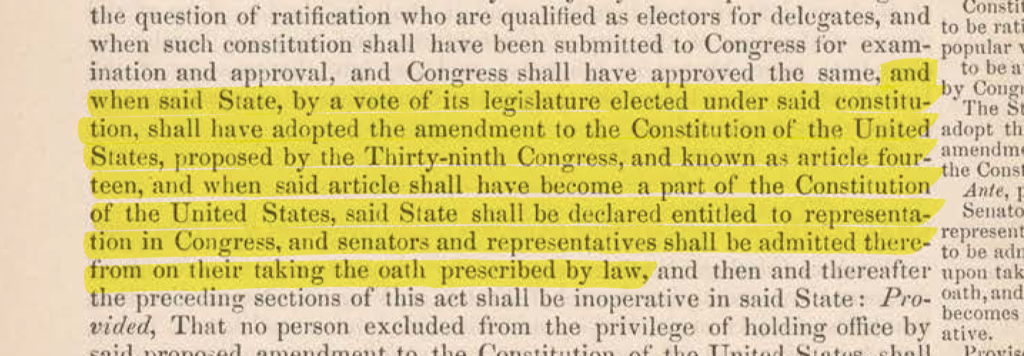
Readmission to Congress was contingent on ratification. Not goodwill. Not moral persuasion.
A legal condition.
George Washington University Law School scholar Thomas B. Colby documented what that condition looked like in practice:
“And it was ratified not by the collective assent of the American people, but rather at gunpoint. The Southern states had been placed under military rule, and were forced to ratify the Amendment— which they despised with an (un)holy hatred — as a condition of ending military occupation and rejoining the Union.“
These amendments weren’t charity — as the textbooks taught.
They weren’t moral reckoning — as the textbooks taught.
These three amendments were truly forms of coerced ratification — political engineering designed to reabsorb a rebellious South and recollect congressional power back to The Union.
Understanding who Congress was actually serving changes how you read every word of these amendments — and how it affects your rights and privileges…
What Event Led to the 13th, 14th, and 15th Amendments? (Myths Revealed)
Common Problem: None of what these amendments did makes sense without first burying three myths about what came before them.
Myth 1: The Civil War Was Fought to Free the Slaves
The war was a conflict over property, economic philosophy and the balance of federal versus state power. The divide between an agricultural South and an industrializing North — competing visions of banking, taxation, commerce and labor — was the engine of that conflict. Enslaved people were unfortunately a major form of property in the legal and economic sense: valuable, quantifiable and contested.
Economist Roger Ransom of the Economic History Association put a number on it:
“In 1805 there were just over one million slaves worth about $300 million; fifty-five years later there were four million slaves worth close to $3 billion.“
To put that in terms we feel today: as of 2026, $3 billion from 1855 is equivalent in purchasing power to approximately $112 billion. The bloodiest war in American history wasn’t fought over principle. It was fought over property — and sadly, $112 billion worth of the property were human beings.
Remember that figure — 4 million enslaved. We’re coming back to it.
Some historians called the war a “Second American Revolution” — one in which Northern industrial capitalists, who wanted to profit off the oncoming industrial revolution, seized power from the planter class through tariff, banking and railroad legislation — not abolitionists, as many have been led to believe.
The enslaved were the asset at the center of a larger economic dispute. Their freedom was the consequence of a power struggle, not a moral purpose.
Myth 2: The Emancipation Proclamation Freed the Slaves
It did not — only a small percentage…
Abraham Lincoln’s 1863 proclamation applied only to enslaved people in Confederate states — and only as a wartime executive maneuver, calculated to spark rebellion behind enemy lines and destabilize the Confederacy’s labor base. The enslaved people in Union-loyal border states — Kentucky, Missouri, Maryland, Delaware — were untouched. Deliberately.
The proclamation named, by state, exactly where it applied:
Arkansas. Texas. Louisiana. Mississippi. Alabama. Florida. Georgia. South Carolina. North Carolina. Virginia.
That’s it.
The National Archives confirms:
“It applied only to states that had seceded from the Union, leaving slavery untouched in the loyal border states.” The Library of Congress makes clear Lincoln framed the order explicitly “as a fit and necessary military measure” — not a moral declaration.
The National Constitution Center’s own interpretation concludes the Emancipation Proclamation did not, in fact, free the slaves.
Remember those 4 million enslaved people?
The American Civil War Museum estimates that only ~1 million were freed by war’s end through the Proclamation.
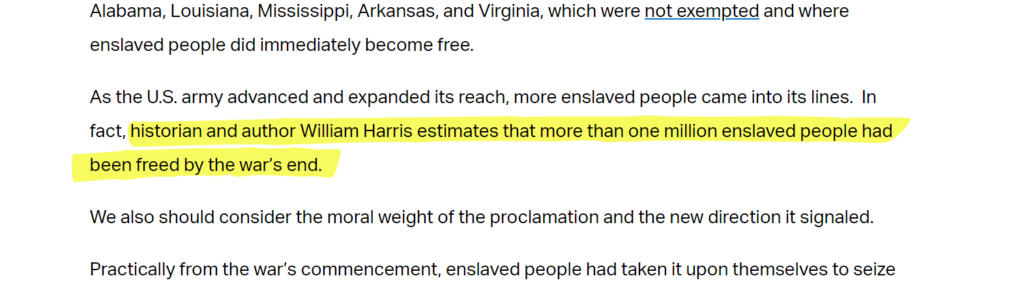
That means by the most generous count, the Emancipation Proclamation freed roughly 25% of enslaved people. The remaining 75% stayed in bondage until 1865 — and what freed them leads directly to the next myth..
Myth 3: The Emancipation Proclamation Was a Law
Nope.
The Emancipation Proclamation was an executive order. A Presidential decree.
It carried the legal permanence of a wartime emergency measure — which does pack a “legal punch”, but isn’t nearly as powerful as a law. Which means Congress could overrule it with a single vote.
And Lincoln’s own cabinet knew this.
The Reagan Presidential Library’s analysis of the 13th Amendment describes the Emancipation Proclamation as “Proclamation 95” and confirms that Lincoln and his team “were aware that the elimination of slavery had to be legally certified in order to last beyond the war.”
Cornell Law’s Constitutional Annotated text states plainly: “there was a general conviction that its effect would not last beyond the restoration of the seceded states to the Union.”
The Northern States needed something more durable.
Because the most celebrated act of emancipation in American history was never a viable law. It was an executive order, a band-aid on an old American wound where stitches were actually needed.
Why Did the 13th Amendment Need to Be Issued and Passed?
“Neither slavery nor involuntary servitude, except as a punishment for crime whereof the party shall have been duly convicted, shall exist within the United States, or any place subject to their jurisdiction.” — Amendment XIII, U.S. Constitution
What It (Actually) Did
The 13th Amendment abolished slavery and involuntary servitude throughout the United States, granted Congress the power to enforce abolition through legislation and satisfied Northern states demanding a permanent, court-proof end to the institution. — this all indeed is a fact.
Except — read this one clause again. Slowly.
“Except as a punishment for crime whereof the party shall have been duly convicted.”
Historians, legal analysts, Constitutional lawyers and many more all agree: this clause is not a footnote. It is not an oversight. It is a mechanism.
And the evidence suggests that this clause is why (and how) the 13th Amendment swayed enough of the Unionists and Democrats to vote “aye” and actually pass the amendment..
You see…
To reach the required three-fourths majority to add an amendment to the Constitution — 27 of the 36 states at that time — ratified the Amendment by December 6, 1865.
Across both chambers, the amendment received 100% unanimous support from Republicans, 77.4% support from Unionists and 77.5% opposition from Democrats — who represented prior Confederate states.
It passed.
Slavery was abolished (well sort of)…
Slavery Wasn’t Completely Abolished. It Was Redefined.
The 13th Amendment didn’t end slavery entirely — it legalized a new version of it, one administered not by slaveholders but by the criminal justice system.
This is not an interpretation.
This is the text — and historians, legal scholars and the government’s own records have spent 150 years proving it.
The National Constitution Center states it plainly:
“The Amendment does allow a person convicted of a crime to be forced to work. Thus, prison labor practices, from chain gangs to prison laundries, do not run afoul of the Thirteenth Amendment.“
And what happened next was predictable — and it was predicted. The Library of Congress documents how the exception clause “was used to create a prison convict leasing system of involuntary servitude to fill the labor supply shortage“ in the post-war South.
Black Codes criminalized walking on the grass, vagrancy and stealing food. Professional crime hunters were paid per arrest. Apprehensions spiked during labor shortages — not crime waves.
Companies paid leasing fees to state governments in exchange for prisoner labor in mines, railroads and lumber yards. The Equal Justice Initiative records that over 3,500 prisoners died in Texas alone between 1866 and 1912 under this system.
But how does the convict leasing practices of that day connect to the prison pipeline of today?
Remember the 4 million enslaved people counted in 1860?
Today, an estimated 5.6 million Americans are living under some form of modern day slavery in America — either through incarceration, probation or parole — controlled by the same system the 13th Amendment built a legal door for.
That’s an estimated 1.9 million “Black” Americans are incarcerated or under community supervision in the United State. — in addition to 1.2 million “Hispanic/Latino” Americans…
But it gets worse…
Because like any amendment, the 13th isn’t necessarily permanent…
Take the 18th Amendment for example, which banned the production, transport and sale of alcohol, later repealed by the 21st amendment — the 13th can too be repealed.
The 13th amendment is not necessarily permanent protection. It is an amendment with a loophole large enough to drive a century of mass incarceration through.
What It Didn’t Do
Freedom without citizenship is a hollow grant.
The 13th gave the formerly enslaved a sense of liberty but not citizenship — no legal standing, no enforceable rights, no pathway to due process, no protection from the state that had just claimed to free them.
And that gap set the stage for the 14th Amendment…
The exception clause isn’t a footnote. It’s the blueprint. If this is the first time you’re reading the 13th Amendment this way — The Constitutional Blackoutis where you begin unlearning the lies we all have been taught and start learning how to reclaim your true Constitutional rights.
The 14th Amendment (Ratified 1868)
“All persons born or naturalized in the United States, and subject to the jurisdiction thereof, are citizens of the United States and of the State wherein they reside. No State shall make or enforce any law which shall abridge the privileges or immunities of citizens of the United States; nor shall any State deprive any person of life, liberty, or property, without due process of law; nor deny to any person within its jurisdiction the equal protection of the laws.” — Amendment XIV, Section 1, U.S. Constitution
What It (Secretly) Did
The 14th Amendment created a new class of federal citizenship — citizens of the United States — distinct from the prior understanding of State Citizens. Before 1868, citizenship was determined by the state in which you lived. Your rights were your state’s business.There was no Constitutional federal citizenship class — until the 14th Amendment…
The Heritage Foundation’s constitutional analysis confirms the shift:
“The Fourteenth Amendment made United States citizenship primary and state citizenship derivative. The primacy of federal citizenship made it impossible for states to prevent former slaves from becoming United States citizens by withholding state citizenship.”
The 14th Amendment also gave the impression of overturning the Dred Scott decision — the 1857 Supreme Court ruling that declared no person of African descent could hold U.S. Citizen status and had “no rights which the white man was bound to respect.” But the new category created by the 14th Amendment was a lower-classed (and lower-cased) citizen — not a Citizen.
The distinction carries legal weight that an entire future article will unpack.
Beyond citizenship, the 14th barred former Confederate officeholders from future federal or state office, voided Confederate war debts, made any compensation for “lost” enslaved people illegal and dramatically expanded federal power over state governments.
The Real Work the 14th Was Doing
Remember Noble Drew Ali’s words:
“The 14th and 15th Amendments brought the North and South in unit, placing the Southerners who were at that time without power, with the constitutional body of power.”
That’s not a secondary effect. That was the primary mission.
For the South, the 14th Amendment was the price of readmission. Ratification wasn’t a civic gesture — it was a condition of survival. Without ratifying the 14th Amendment, confederate states couldn’t send representatives to Congress, couldn’t reclaim their political voice, until they put their signature on this document.
For the North — specifically, for the Republican-controlled Congress — the 14th consolidated federal power at a scale that hadn’t existed before 1868. Congressman Thaddeus Stevens said the quiet part out loud: the amendments were designed to ensure “perpetual ascendancy to the party of the Union.” Power. Not principle.
The Fine Print: Rights vs. Privileges and Immunities
Here is where the language does its most dangerous work…
The 14th Amendment doesn’t grant rights. It grants “privileges and immunities.“
These are not the same thing. Rights are inherent — they exist independent of government and are simply protected by the government, not given by the government.
Privileges are given or granted by authority and can be revoked by authority. Privileges are temporary — limited by time.
This is what makes a person in America what is considered a Second-Classed Citizen…
“We see this with our people who call themselves negro, black and colored — and are recognized as a citizen by time” — Emmanuel Braswell Bey, Supreme Grand Sheik and Chairman of the Moorish Science Temple of America.
The Supreme Court confirmed exactly how narrow this distinction was in The Slaughter-House Cases of 1873 — just five years after ratification — ruling that the Privileges or Immunities Clause applied only to a narrow class of federal citizenship rights.
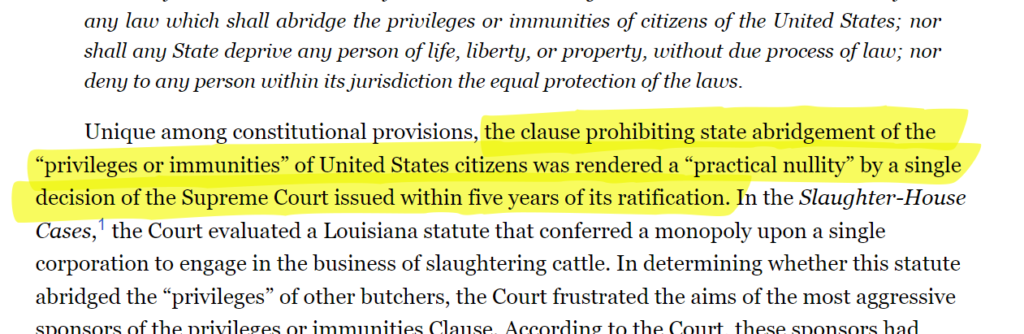
Congress.gov’s Constitutional Annotated calls it what it was: the clause was “rendered a practical nullity by a single decision of the Supreme Court issued within five years of its ratification.”
The amendment that was supposed to elevate a people had an asterisk* added to it before the ink was dry on a the paper.
The 14th didn’t give any of us first-class citizenship and rights. It gave a lower class of citizenship and privileges…
And privileges can be taken away at any time.
The 15th Amendment (Ratified 1870)
“The right of citizens of the United States to vote shall not be denied or abridged by the United States or by any State on account of race, color, or previous condition of servitude.” — Amendment XV, Section 1, U.S. Constitution
What It Did
The 15th Amendment prohibited denying the right to vote on the basis of race, color or previous condition of servitude and gave Congress enforcement power through appropriate legislation.
On paper: the right to vote.
In practice: a negative framing that handed the South a blueprint for circumvention.
What It Left Out —
Women received no mention. None.
The omission fractured the suffrage movement.
Elizabeth Cady Stanton called it a betrayal.
Sojourner Truth noted the silence on “the colored woman.”
It would take another 50 years — the 19th Amendment, 1920 — before that exclusion was addressed.
The amendment also established the right without guaranteeing the vote would be counted.
It listed the conditions under which voting could not be denied — which immediately handed state legislatures a different question: what conditions could they invent that weren’t on that list?
How the South Answered That Question
Poll taxes. Literacy tests. Grandfather clauses — exemptions for anyone whose grandfather had voted before 1866, when no Black man had been legally permitted to vote. All technically race-neutral. All surgically designed to strip the franchise from the very people the 15th was written to protect.
The Supreme Court’s first voting rights ruling under the 15th — United States v. Reese (1876) — made clear the amendment did not actually confer the right to vote, only prohibit discrimination in its administration. That narrow reading gave states everything they needed.
The South didn’t need to repeal the 15th Amendment at the federal level. They just needed to recognize the loopholes in the 15th Amendment and fight their battles at the state and local levels. And that’s exactly what they did.
Were the 13th, 14th, and 15th Amendments Successful?
For The Union — unambiguously yes.
The 13th abolished slavery on paper. The 14th and 15th pulled the South back into the constitutional body of power, restored their congressional representation and reestablished federal authority over a broken Union. The political objective was accomplished. The Union won.
But for the people these amendments were said to protect — the answer is equally unambiguous.
“The 14th and 15th Amendments brought the North and South in unit, placing the Southerners who were at that time without power, with the constitutional body of power. And at that time, 1865, the free national constitutional law that was enforced since 1774 declared all men equal and free, and if all men are declared by the free national constitution to be free and equal since that constitution has never been changed, there is no need for the application of the 14th and 15th Amendments for the salvation of our people and citizens.“ — Noble Drew Ali, Moorish Literature
The Failure of the Reconstruction Amendments (With Proof)
13th Amendment: Mass incarceration is not a malfunction of the 13th Amendment — it is the amendment functioning exactly as written.
The bodies changed hands from plantation owners to the prison wardens. The clause stayed the same.
And like Prohibition — the 18th Amendment, repealed by the 21st — the 13th Amendment can be undone.
14th Amendment: The 14th created a new citizenship class engineered to serve two populations simultaneously: the formerly enslaved who needed to be absorbed into the body politic and the rebellious Southerners who needed to be reintegrated into it. The Due Process and Equal Protection clauses were then functionally ignored for nearly a century. Brown v. Board of Education didn’t arrive until 1954. The Civil Rights Act, 1964.
15th Amendment: The 15th excluded women entirely. It stripped the franchise from anyone convicted of a felony — reducing incarcerated people to zero-fifths of a political voice. It applied to citizens of the United States — not Citizens of the United States of America. The distinction carries legal weight that the article’s follow-up will unpack in full. Most telling: the Voting Rights Act of 1965 — enacted 95 years after the 15th Amendment — carried the official title “An Act to Enforce the Fifteenth Amendment.” A law passed to enforce a constitutional amendment is not evidence of progress. It is evidence of failure.
What Followed: Jim Crow Was the Direct Outcome
The Black Codes, poll taxes, literacy tests, grandfather clauses and the full architecture of segregation were not a failure of the Reconstruction Amendments. They were the predictable result of amendments designed with enough flexibility to be systematically circumvented.
The loopholes were not found — they were built in.
Does the Constitution Protect Everyone But You?
You came in with the textbook answer. You’re leaving with the truth based on evidence and undeniable proof — and the understanding that the gap between those two things was never accidental. You now have both answers. The “official” one. And the real one.
Now comes the harder question…
What are your actual rights? And how do you claim them without begging the same system for permission?
That’s exactly what The Constitutional Blackout was built to answer. It’s a FREE direct-to-your-inbox series that goes where this article can’t — deeper into the documents, the distinctions and the truths that have been buried under 150 years of miseducation.
Here’s what’s waiting for you inside:
- Citizens vs. citizens — the two classes hiding in plain sight in the same document, and why the difference determines everything about your legal standing
- U.S. vs. U.S.A. — why the distinction between the United States and the United States of America is not a conspiracy theory but a documented constitutional reality
- What the Constitution actually says about your rights — in plain, unambiguous terms, with primary sources at every turn
- Why birthright citizenship is under attack right now — and what the 14th Amendment’s fine print means for you and your children in 2026 and beyond
- The hidden classes of citizenship built into the founding documents — and which one you actually hold
- Why every civil rights law since 1865 has been a patch on a broken system — and what your ancestors understood about natural law that each generation has been trained to forget
- The Voting Rights Act, the Civil Rights Act and the truth about what they actually secured — and what they deliberately left out
With Constitutional Blackout there’s no:
❌ Algorithms to decide what you see.
❌Paywall to block your access.
❌Textbook illusions to distract you.
✅Just the pure truth…