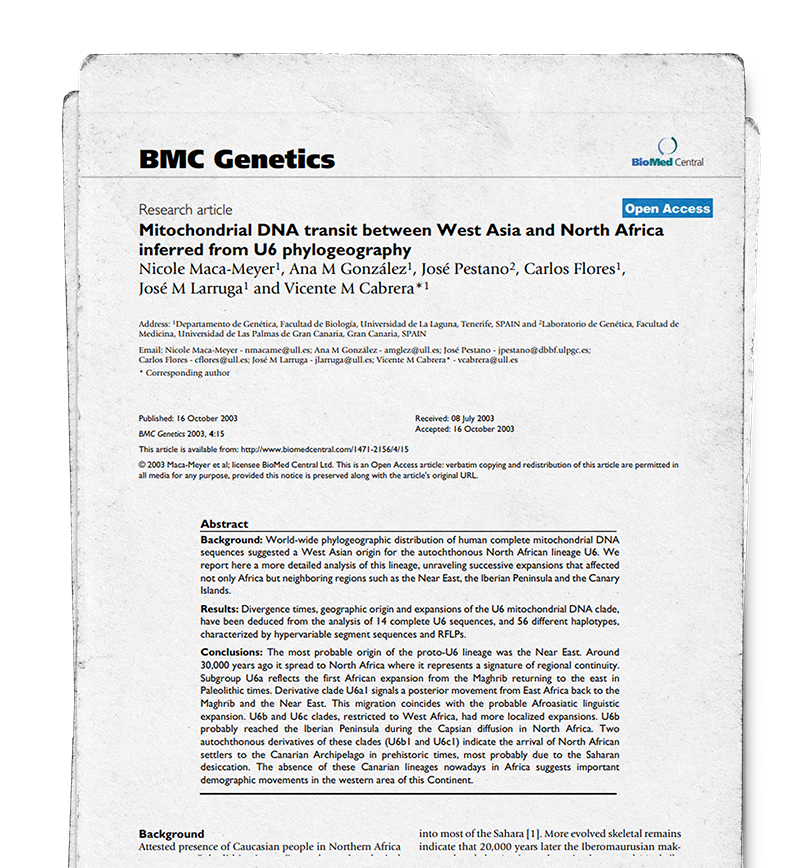
The most probable origin of the proto-U6 lineage was the Near East. Around30,000 years ago it spread to North Africa where it represents a signature of regional continuity.
Subgroup U6a reflects the first African expansion from the Maghrib returning to the east in Paleolithic times.
Derivative clade U6a1 signals a posterior movement from East Africa back to the Maghrib and the Near East.
This migration coincides with the probable Afroasiatic linguistic expansion. U6b and U6c clades, restricted to West Africa, had more localized expansions.
U6b probably reached the Iberian Peninsula during the Caspian diffusion in North Africa.
Two autochthonous derivatives of these clades (U6b1 and U6c1) indicate the arrival of North African settlers to the Canarian Archipelago in prehistoric times, most probably due to the Saharan desiccation.
The absence of these Canarian lineages nowadays in Africa suggests important demographic movements in the western area of this Continent.