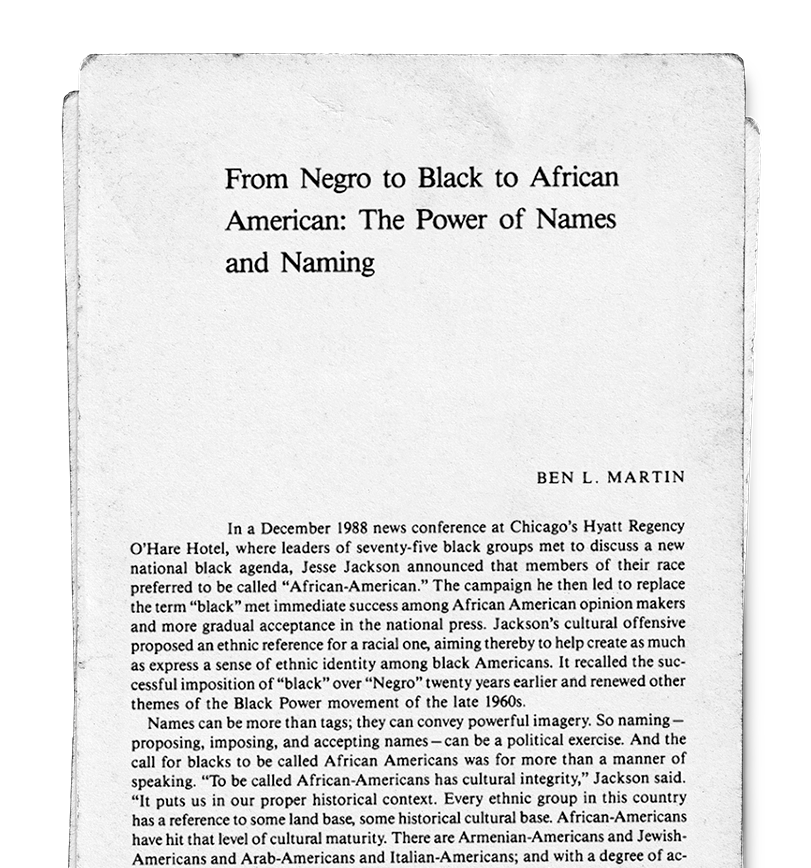
The campaign he then led to replace the term “black” met immediate success among African American opinion makers and more gradual acceptance in the national press. Jackson’s cultural offensive proposed an ethnic reference for a racial one, aiming thereby to help create as much as express a sense of ethnic identity among black Americans. It recalled the successful imposition of “black” over “Negro” twenty years earlier and renewed other themes of the Black Power movement of the late 1960s. Names can be more than tags; they can convey powerful imagery. So naming proposing, imposing, and accepting names -can be a political exercise. And the call for blacks to be called African Americans was for more than a manner of speaking.
“To be called African-Americans has cultural integrity,” Jackson said. “It puts us in our proper historical context. Every ethnic group in this country has a reference to some land base, some historical cultural base. African-Americans have hit that level of cultural maturity. There are Armenian-Americans and Jewish Americans and Arab-Americans and Italian-Americans; and with a degree of accepted and reasonable pride, they connect their heritage to their mother country and where they are now.”